The Complete Guide to Commercial Refrigeration Controls
A practical guide to commercial refrigeration controls, covering how they work, energy efficiency and reliable system performance.
Commercial refrigeration controls manage how different components operate and respond to changing conditions. From maintaining temperature and controlling compressors to managing defrost cycles and identifying faults, controls play an important role in the efficiency, reliability and day-to-day operation of a refrigeration system.
As refrigeration technology develops and businesses look for ways to reduce energy consumption, the role of controls is becoming increasingly important. This guide explains how commercial refrigeration controls work, the different functions they perform and what businesses should consider when specifying or upgrading them.
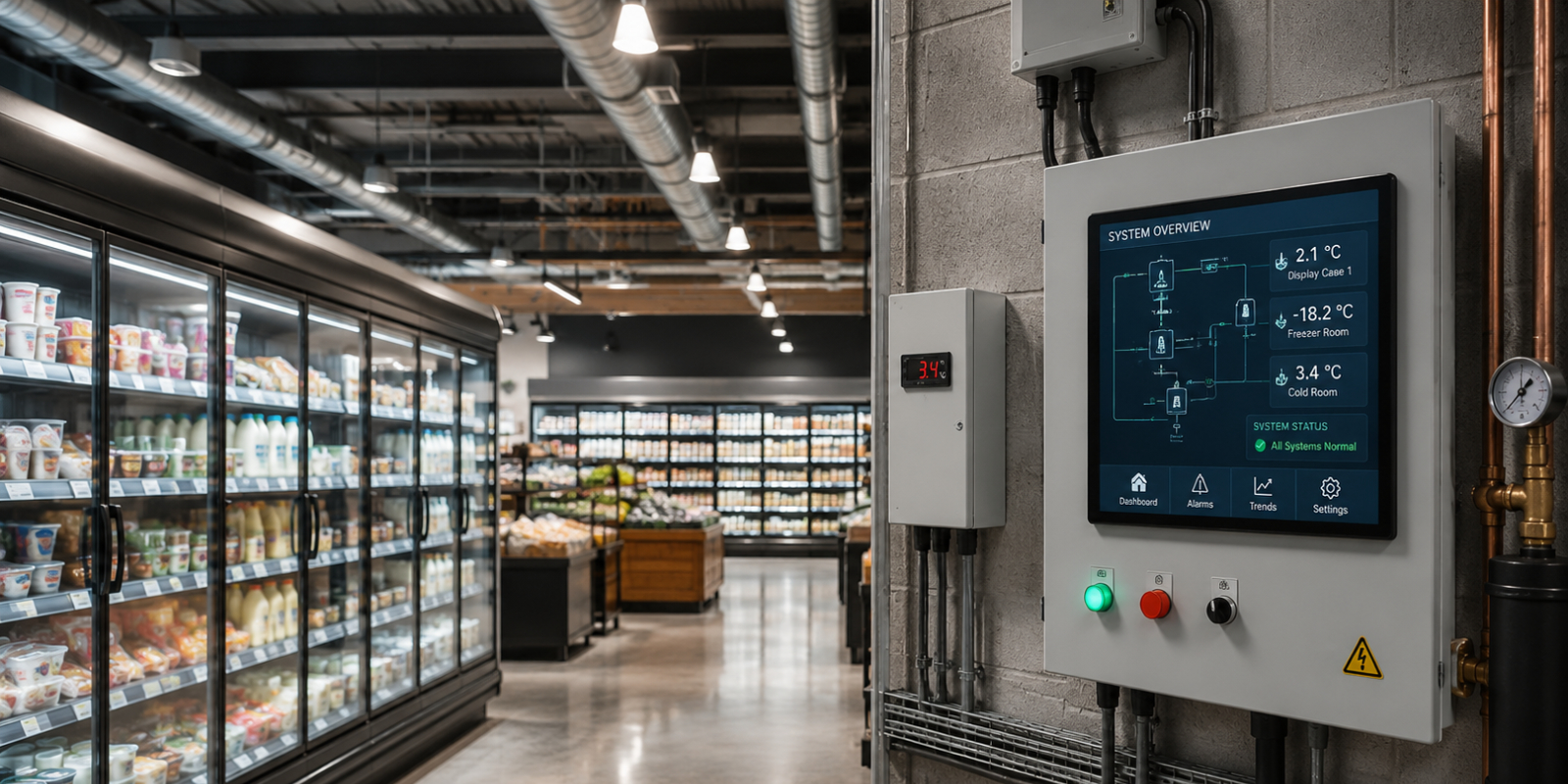
What Are Commercial Refrigeration Controls?
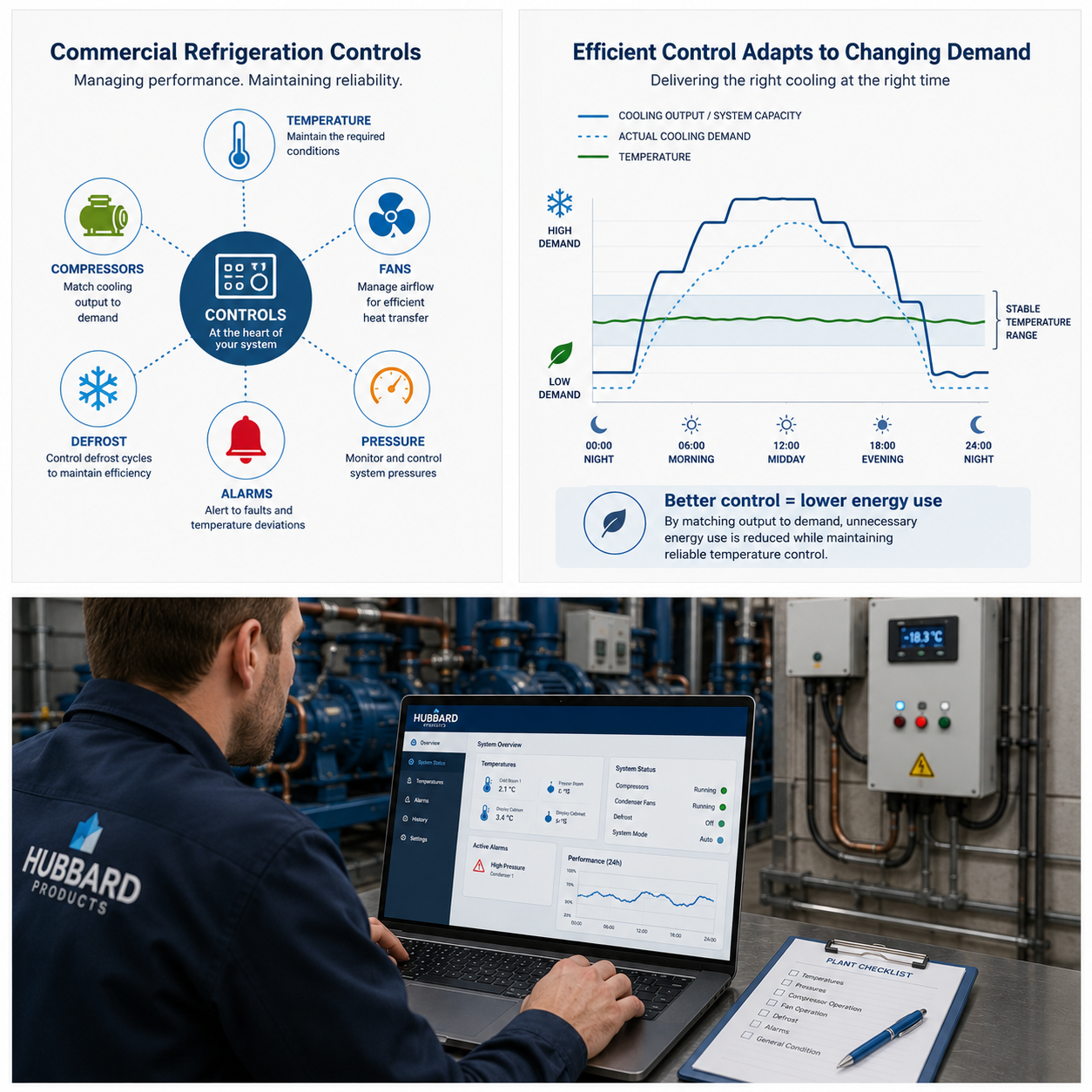
- Temperature - Maintaining the required conditions within refrigerated cabinets, cold rooms or other temperature-controlled areas.
- Compressors - Controlling compressor operation and helping match refrigeration capacity to demand.
- Fans - Managing condenser and evaporator fans to support efficient heat transfer.
- Defrost Cycles - Controlling when evaporators are defrosted and helping prevent unnecessary defrost cycles.
- Pressure - Monitoring and controlling operating pressures within the refrigeration system.
- Alarms - Alerting users or engineers to temperature deviations, faults or abnormal operating conditions.
- System Performance - Providing information that can help engineers assess how the equipment is operating and identify potential problems.
The level of control required will depend on the application. A relatively small commercial refrigeration system may have straightforward requirements, while a supermarket, food production facility or larger retail installation can involve multiple refrigerated areas operating at different temperatures.
Why Are Refrigeration Controls So Important?
Commercial refrigeration often operates continuously. Even relatively small inefficiencies can therefore accumulate over thousands of operating hours each year. Controls help the system provide cooling when it is needed without running equipment unnecessarily.
If a system is poorly controlled, compressors and fans may operate for longer than required, temperatures may fluctuate and components can be subjected to unnecessary operating cycles. As well as increasing energy consumption, this can affect equipment performance and the conditions in which temperature-sensitive products are stored.
Accurate control is particularly important in applications where maintaining a specific temperature range is essential. This can include food retail, food processing, hospitality, pharmaceutical and other temperature-controlled environments.
The aim is not simply to reduce the running time of the refrigeration system. It is to make it respond more effectively to actual demand.
The Main Types of Commercial Refrigeration Controls
Refrigeration controls can perform several different functions within the same system.
Temperature Controls
Temperature control is at the heart of any refrigeration system. Sensors monitor conditions within the refrigerated space and communicate with the control system. When the temperature moves outside the required parameters, the refrigeration equipment responds accordingly.
Accurate temperature control helps maintain suitable product storage conditions while avoiding unnecessary cooling. The positioning, calibration and condition of temperature sensors are therefore important considerations when assessing refrigeration performance.
Compressor Controls
The compressor is one of the major energy-consuming components within a refrigeration system, making effective compressor control particularly important. Rather than operating continuously, compressors can be controlled according to refrigeration demand. The approach will depend on the equipment and compressor technology being used.
Commercial refrigeration systems can use technologies including hermetic, semi-hermetic, scroll and digital scroll compressors. The control strategy needs to work with the particular compressor technology to deliver the required capacity efficiently.
Where cooling demand changes significantly throughout the day, the ability to adjust capacity can help prevent unnecessary energy use during periods of lower demand.
Fan Controls
Fans are used within condensers and evaporators to move air and support heat transfer.
Controls can manage when fans operate and, where the equipment allows, how their output responds to changing conditions. This can help reduce unnecessary fan operation while maintaining the airflow required by the refrigeration system.
Although individual fan motors may represent a smaller load than compressors, improvements can become significant when multiple fans operate for long periods.
Defrost Controls
Ice can accumulate on evaporator coils during normal refrigeration operation. If it is allowed to build up, airflow and heat transfer can be restricted, reducing system performance.
Defrost cycles remove this ice, but defrosting also uses energy and temporarily interrupts normal cooling.
Effective defrost control therefore aims to achieve the right balance. Defrost must take place when required without occurring more frequently or for longer than necessary.
The appropriate approach will depend on the refrigeration application, operating temperature, equipment and environmental conditions.
How Do Commercial Refrigeration Controls Reduce Energy Consumption?
Energy efficiency is one of the main reasons to look more closely at how a refrigeration system is controlled. Commercial refrigeration can operate around the clock and cooling demand is rarely constant. Ambient temperature, product loading, door openings and trading patterns can all affect the amount of cooling required at different times.
A well-controlled system can respond to these changes rather than operating at maximum output regardless of demand. Controls can contribute to lower energy consumption by:
- Matching refrigeration capacity more closely to actual cooling demand.
- Reducing unnecessary compressor operation.
- Managing condenser and evaporator fans more effectively.
- Optimising defrost cycles.
- Maintaining more stable operating conditions.
- Highlighting abnormal operation that may be increasing energy consumption.
Controls should not, however, be viewed in isolation. The greatest opportunities for improved efficiency usually come from considering the refrigeration system as a whole, including the compressors, condensers, evaporators, refrigerant, controls and the conditions in which the equipment operates.
Refrigeration Controls and Changing Cooling Demand
One of the challenges facing commercial refrigeration systems is that demand changes constantly.
A refrigerated display cabinet in a busy shop, for example, may experience increased cooling demand as doors are opened, products are loaded and ambient conditions change. Overnight, demand may fall considerably. Similarly, outdoor temperature changes affect the conditions under which condensers operate.
Controls allow the refrigeration system to respond to these changing requirements. Instead of treating every hour of operation in the same way, the system can adjust its operation according to what is actually happening. This ability to respond to demand is increasingly important as businesses look to reduce energy consumption without compromising refrigeration performance.
Controls, Alarms and System Monitoring
Refrigeration controls can also provide valuable information about how a system is operating. Depending on the equipment and control system, alarms can identify issues such as temperature deviations or equipment faults. This can give operators or refrigeration engineers an earlier indication that attention may be required.
Monitoring operating information can also help identify patterns that would otherwise be difficult to see. A compressor running for unusually long periods, repeated alarms or changes in temperature behaviour may indicate that part of the system needs investigation.
Controls can therefore support maintenance as well as day-to-day operation. Identifying an emerging problem before it results in equipment failure can help reduce disruption and protect temperature-sensitive stock.
What Are Smart Refrigeration Controls?
Refrigeration controls have developed considerably from simple mechanical thermostats.
Modern controls can provide greater visibility of equipment operation and allow more aspects of the refrigeration system to be managed together.
Depending on the application and equipment, this can include more detailed operating information, alarms and system data that can help businesses and refrigeration engineers understand how equipment is performing.
For businesses operating larger refrigeration installations or multiple locations, this information can support a more consistent approach to managing refrigeration assets.
Smart control does not remove the need for good refrigeration system design or maintenance. However, it does provide an invaluable way to understand and optimise the performance of the equipment.
Commercial Refrigeration Controls and Modern Refrigerants
The commercial refrigeration sector is continuing to change as businesses move towards refrigerants with lower global warming potential. This includes increased use of solutions based around CO₂ and lower-GWP refrigerants, alongside changes to refrigeration equipment and system design. Controls need to be considered as part of this transition.
Different refrigeration technologies have different operating characteristics, which means the control strategy needs to be appropriate for the equipment, refrigerant and application.
When upgrading an existing installation or specifying new equipment, it is therefore important to look at the complete refrigeration system rather than selecting individual components in isolation.
Choosing Controls for Different Commercial Applications
There is no single commercial refrigeration control solution suitable for every business. A convenience store, supermarket, restaurant, food production site and cold room can all have very different refrigeration requirements. Important considerations include:
- The required operating temperature.
- The size and cooling load of the refrigerated area.
- The number of refrigerated cabinets, rooms or zones.
- The compressor and refrigeration technology being used.
- The refrigerant.
- Variations in cooling demand.
- Energy efficiency requirements.
- Monitoring and alarm requirements.
- Existing equipment where controls are being upgraded rather than installed as part of a new system.
Understanding how the refrigeration equipment will actually be used is essential. A control strategy that works well in one application may not provide the same benefits in another.
When Should Refrigeration Controls Be Upgraded?
Refrigeration controls do not necessarily need to fail before they should be reviewed.
Older controls may continue to operate but without the accuracy, flexibility or information available from newer technology. The wider refrigeration system may also have changed since the controls were originally installed. Signs that refrigeration controls could benefit from review include:
- Inconsistent or fluctuating temperatures.
- Higher than expected energy consumption.
- Frequent compressor cycling.
- Recurring alarms or faults.
- Unnecessary or excessive defrost cycles.
- Limited visibility of system performance.
- Changes to refrigeration equipment or operating requirements.
- Difficulty maintaining the required conditions during periods of high demand.
Upgrading controls does not always mean replacing the entire refrigeration system. Depending on the condition and compatibility of the existing equipment, improving the control strategy may help increase efficiency and make better use of existing refrigeration assets.
Controls as Part of the Complete Refrigeration System
The effectiveness of commercial refrigeration controls ultimately depends on the equipment they are managing. Compressors, condensers, evaporators, sensors and controls all need to work together. Equipment selection, system design, installation, commissioning and ongoing maintenance also influence the performance that can be achieved.
Hubbard provides commercial refrigeration solutions covering a wide range of applications, with equipment including scroll, digital scroll, semi hermetic and hermetic condensing units, condensers, evaporators and control panels. This allows the control requirements to be considered alongside the wider refrigeration system rather than as an afterthought.
For businesses investing in new refrigeration equipment or looking to improve an existing installation, taking this complete-system approach can help deliver more consistent temperatures, better energy performance and reliable operation over the longer term.Talk to Hubbard About Commercial Refrigeration Controls
Choosing the right commercial refrigeration controls starts with understanding the demands placed on the complete system.
Whether you’re planning a new installation, upgrading existing equipment or looking for opportunities to improve refrigeration performance, Hubbard can help you find the right refrigeration and control solution for your application. Talk to Our Team